
Pool Gate Hinges
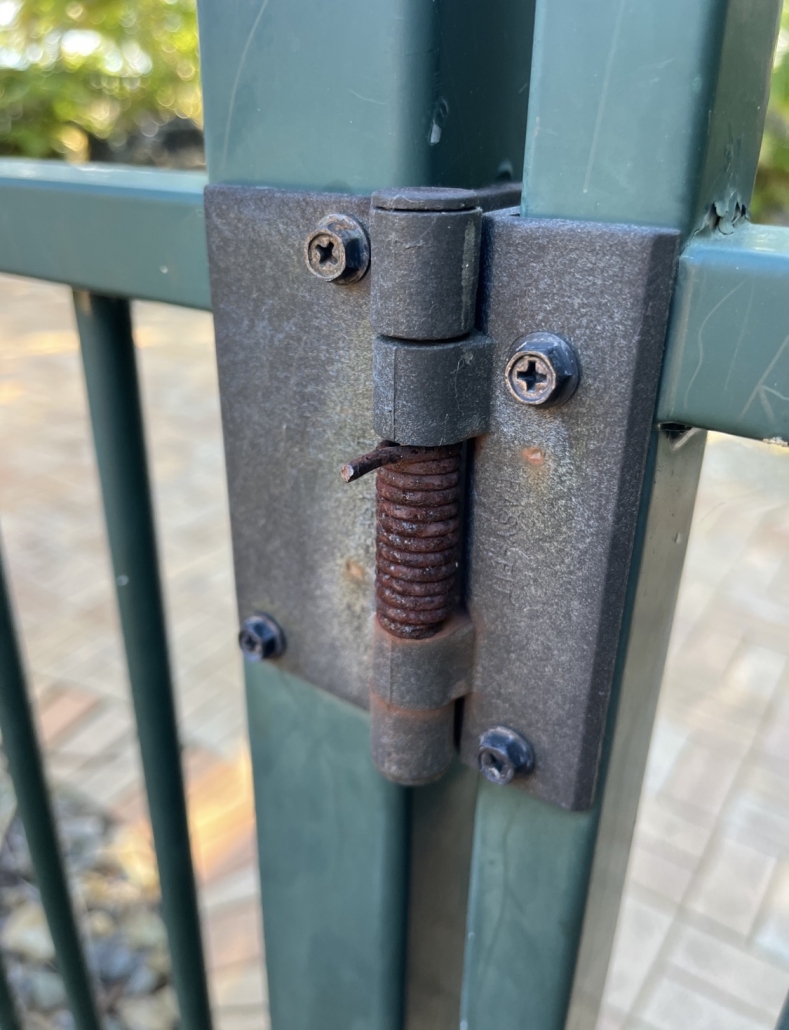
Pool gate hinges are one of the hardest-working components of any swimming pool barrier. Every time the gate is opened and closed, the hinges are responsible for returning it to the closed position so that the latch can engage automatically.
Without correctly operating hinges, even the best pool gate latch cannot perform its job.
During Pool Safety Inspections throughout the Gold Coast, worn or poorly adjusted hinges are one of the most common reasons pool gates fail to self-close correctly.
Fortunately, most hinge problems are straightforward to identify and rectify.
What Do Pool Gate Hinges Do?
Unlike ordinary household gate hinges, pool gate hinges are designed to automatically return the gate to the closed position after it has been opened.
These self-closing hinges are an essential safety feature required under Queensland pool safety legislation.
The hinges must generate enough closing force to ensure the gate closes and allows the latch to engage securely without assistance.
How Are Hinges Tested During an Inspection?
During a Pool Safety Inspection, the hinges are assessed by repeatedly opening and closing the gate from different positions.
Your licensed Pool Safety Inspector will check that the gate:
- Self-closes from the fully open position.
- Self-closes from approximately halfway open.
- Self-closes from only slightly open.
- Closes smoothly without sticking.
- Does not drag on the ground.
- Allows the latch to engage every time.
If the hinges fail any of these tests, adjustment or replacement may be required.
Why Do Pool Gate Hinges Fail?
Although pool gate hinges are designed for outdoor conditions, they are constantly exposed to:
- Rain.
- Sun.
- Salt air.
- Wind.
- Regular daily use.
Over time this can lead to:
- Loss of spring tension.
- Wear within the hinge mechanism.
- Corrosion.
- Loose fixings.
- Gates gradually dropping under their own weight.
Even slight movement can prevent the gate from closing correctly.
Common Signs Your Hinges Need Attention
You may notice:
- The gate closes more slowly than it used to.
- The gate stops before reaching the latch.
- The gate scrapes on the ground.
- The latch only works if the gate is pushed.
- The gate appears uneven.
- The hinges squeak or feel stiff.
These are all signs that maintenance should be carried out before your next inspection.
Can Hinges Be Adjusted?
In many cases, yes.
Quality adjustable hinges can often be re-tensioned or realigned to restore correct operation.
However, cheaper non-adjustable hinges may eventually require replacement once they begin to wear.
During a recent inspection in Ashmore, an aluminium pool gate had dropped over time and was catching before reaching the latch. The existing hinges were a non-adjustable type and could not be realigned.
The solution was to replace the hinges with adjustable self-closing hinges, rehang the gate and realign the latch. Once completed, the gate self-closed and self-latched correctly, allowing the pool barrier to achieve compliance.
How to Extend the Life of Your Hinges
Regular maintenance helps maximise the life of your pool gate hinges.
We recommend:
- Testing the gate every month.
- Keeping hinges free from dirt and debris.
- Washing salt residue from hinges if you live near the coast.
- Tightening loose screws where appropriate.
- Having hinges adjusted as soon as the gate begins to slow or drag.
- Replacing worn hinges before they fail completely.
Small maintenance tasks can prevent larger repair costs later.
Why Professional Adjustment Matters
Many homeowners attempt to adjust their gate themselves.
While some minor adjustments are straightforward, incorrect hinge tension can actually make the gate perform worse or prevent it from latching correctly.
A licensed Pool Safety Inspector can quickly identify whether the issue lies with the hinges, the latch, the gate alignment or another part of the barrier.
From the Inspector
Gate hinges are probably the most overlooked component of a swimming pool barrier.
Most people don’t notice a problem because the gate continues to close—just not quite enough to engage the latch every time.
By the time I inspect the property, the owner often tells me, “It was working fine a few months ago.”
In most cases that’s exactly what has happened. The hinges have gradually lost adjustment over time. The good news is that many hinge problems can be corrected quickly before they become major issues.
Why Choose Pool Compliance Gold Coast?
Pool Compliance Gold Coast provides professional Pool Safety Inspections for:
- Homeowners
- Property Sellers
- Landlords
- Property Managers
- Real Estate Agencies
- Body Corporate Managers
We proudly service:
- Helensvale
- Hope Island
- Paradise Point
- Runaway Bay
- Biggera Waters
- Parkwood
- Ashmore
- Benowa
- Carrara
- Clear Island Waters
- Robina
- Varsity Lakes
- Broadbeach Waters
- Mermaid Waters
- Burleigh Waters
and all surrounding Gold Coast suburbs.
We provide practical advice, thorough inspections and professional service to help property owners achieve pool barrier compliance.
Related Articles
- Why Pool Gates Must Self-Close
- Why Pool Gates Must Self-Latch
- Magnetic Pool Gate Latches Explained
- Five Common Reasons Gold Coast Pools Fail Inspection
Contact Pool Compliance Gold Coast
Pool Compliance Gold Coast
Licensed Pool Safety Inspector
✔ Pool Safety Inspections
✔ Pool Safety Certificates
✔ Rental Property Pool Safety Inspections
✔ Pre-Sale Pool Safety Inspections
✉ info@poolcompliancegoldcoast.com.au
🌐 www.poolcompliancegoldcoast.com.au
If your pool gate is slow to close, dragging or failing to latch correctly, contact Pool Compliance Gold Coast today. We can inspect your pool barrier, explain any compliance issues and help you achieve your Pool Safety Certificate quickly and professionally.

